A special thank you to the writer of this article, Sadaf Ahsan, for interviewing me.


Career & Salary Negotiation Coach
You don’t need to contort your work history into a linear career. You know more than you think and you have way more to offer than you realize.
I don’t want to help you cover up your non-linear work history, I want to help you discover and confidently communicate the *value* you bring because of it.
Your difference is your differentiator.
I want to help you transform how you see your skills and experience and ultimately, yourself.
This is what happened with the client below and it’s part of you’ll work on in Guidance Counselling for Adults (registration opens in September but you can apply now to see if we’re a good fit).
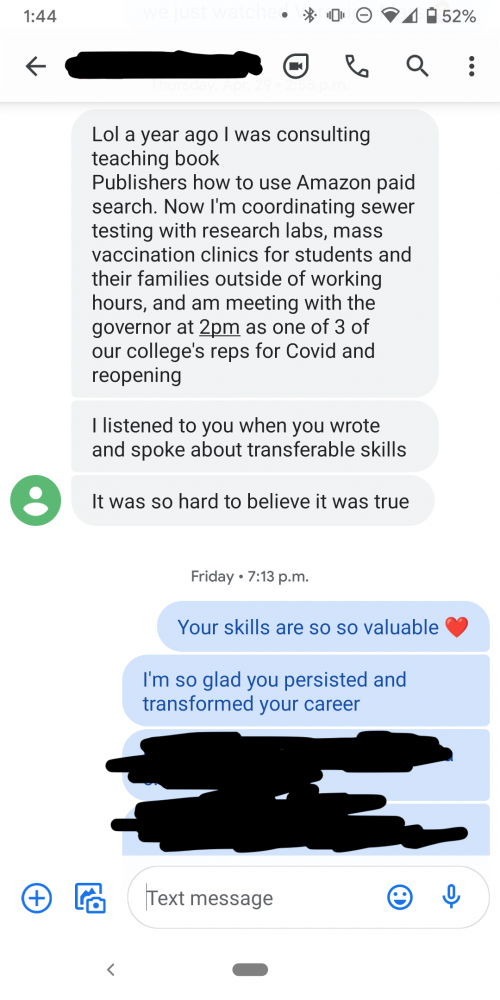
In Guidance Counselling for Adults, you’ll divorce your job titles by unpacking all your roles and detaching your skills out from job titles. Then, we’ll translate them into transferable skills and divorce your job titles.
This is ESPECIALLY important if you’re a generalist or switching careers. My guess is that your titles have never really been an accurate description of what you do. Maybe your current job has expanded past the confines of your official title a while ago?
And if it’s helpful, we can have a “job title divorce party” to help you let go and move on from the titles (and workplaces) that you want to leave behind. Let’s burn it down together.
After that?
No job search burnout for you.
One of the many challenges of figuring out the next step in your career and then actually finding that role is that it feels like a full time job, often while you’re already working. And if you’re unemployed, you have to also fend off panic about finances.
We’ll be intentional with a clear strategy, the right tools, the right connections, and the right action. All tailored to your specific context.
You’ll leave behind information overload and analysis paralysis.
You’ll take calculated, strategic risks with strong, steady support behind you (from moi).
You’ll find out what’s possible without actually knowing what’s out there.
You’ll be able to confidently talk about your experience.
Some of us had better experiences with them than others, but basically guidance counsellors helped us (or at least they were supposed to help us) navigate the confusing world of university, college, and careers. They helped us figure out what we were good at, sometimes with surprising results. The best ones helped us stay true to ourselves–our interests, abilities, and desires–and avoid directions that weren’t the right fit.
Why should this kind of guidance end after high school?
I became a Career and Salary Negotiation Coach because every career move takes us into the unknown, and every person deserves a calm, encouraging, and experienced guide. I’ve worked with over 500 people across 13 countries to help them find jobs they love in less time, and with salary increases up to $50,000. Yup, for real.
I like to think of myself as your caring, warm-hearted, and action-oriented career coach and job search strategist, ready to support you with tools and accountability, and to stick with you through the entire process–from getting clear on what you want all the way through to negotiating your salary.
Click here to read about Guidance Counselling for Adults: https://kathrynmeisner.com/gca
Find out how my decade worth of job searching wisdom, experience, lessons, practical tools, and collaborative methods can help you transform how you see your skills and experience, transform your job search, and land the job (and workplace) that’s right for you.
Let’s get the divorce party started.
Take care,
Kathryn
PS: The summary? Divorce your job titles. I’ll help you do this in Guidance Counselling for Adults which opens in September. You can apply now to see if we’re a good fit.
Since this article is behind a paywall, I’m sharing it here (with permission from the author and the Globe and Mail).
Click here to read this article by Andrea Yu on the Globe and Mail website.
I found out my co-worker is getting paid more than me. What should I say to my bossIf you need support with negotiating or asking for a raise, check out Ask for More, my self-directed online course.
Guidance Counselling for Adults: Find and land the job (and workplace) that’s right for you – without relying on resumes.
A 2-week intensive job search strategy & implementation program plus 6 months of coaching, strategy, structure, accountability, and a learning community.
Time management and procrastination do not come easily to me.
This makes doing things I don’t want to do so. much. harder.
As a result, I’ve had to develop a lot of strategies to cope and to work on these things.
The strategies below are all my personal strategies but they also are strategies that I share with my clients in my one-week intensive, The Pandemic Edition of Guidance Counselling for Adults.
Why?
Because they can also work for your job search.
What I’ve seen with working over 500 clients over the past few years is that you can know all of the strategies about HOW to job search…
But if you don’t have accountability or a way to deal with procrastination and manage your time, it’s really, really hard to figure out your next step and job search.
If I’m having a really hard time focusing or I don’t want to do something, I use the Pomodoro Technique:
You work for 25 minutes straight and then take a 5 minute break.
Apparently its name relates to the Italian word for tomato, “pomodoro” because it’s based on those tomato kitchen timers things and the kitchen timer (or any timer) is essential to the Pomodoro Technique.
The idea is that you can work on anything – no matter how boring or how hard it is – for 25 minutes.
No distractions, no multi-tasking, no checking your phone.
Then you take a screen-free break for 5 minutes.
And then you set the alarm for another 25 minutes.
You do that for a series of four or five rounds and then you take a longer break for 20 or 30 minutes.
This is actually a strategy I use when I facilitate a coworking session with clients in my one-week intensive, The Pandemic Edition of Guidance Counselling for Adults.
We jump online. Everybody says which GCA homework they’re going to work on during that time. And then we Pomodoro.
My Google calendar containts my life.
I’m not a naturally organized person, so I try not to make it too complicated so I don’t get bogged down by the process.
I have several Google calendars that I share with various people:
Sure, sometimes I accidentally add the wrong thing in the wrong calendar but I try give myself permission to be okay with that because getting something in the calendar somehow is better than getting nothing in the calendar.
I live and die by my calendar. So much so that I even send out calendar invites to friends.
Because if it’s not in the calendar, it doesn’t happen.
I time block everything in my calendar.
Not just dates or that kind of thing.
If I need to do a task, I put it in my calendar for the amount of time that it will take as well as some buffer time as well.
If I have to go somewhere (well, when I went places before COVID), I’d actually block in the travel time, when I needed to leave, as well as the travel time home.
I do this for myself but because whoever I’m sharing a calendar with (ie my husband or my assistant), they may need to know how long it’s going to take me to get home or when I’ll be home
I have to find the citation for this but there is research that shows that when you’re touching your phone or have it in your pocket, your brain is constantly staying vigilant looking for an alert.
This means your phone is taking up some of your attention, even when you can’t see it.
The solution?
Put your phone more than one arm’s length away, ideally in another room. And put it on Do Not Disturb so you don’t get any alerts.
These are just a few of my time management and procrastination strategies, ones that I personally use in my life.
I’m not a naturally organized person so I have to develop coping mechanisms to help me do things that I don’t want to do or have been procrastinating on.
And if this sounds familiar, these strategies may be useful for you, too.
They’re also useful for when you’re going through your job search or switching careers.
If you want support – and accountability – with figuring out the next step in your career, check out The Pandemic Edition of Guidance Counselling for Adults and book a time to talk with me.