A special thank you to the writer of this article, Sadaf Ahsan, for interviewing me.


Career & Salary Negotiation Coach
This pandemic is *awful* AND it is still possible to find a better job. You can read some of my key strategies in my interview with The Globe and Mail.
If you want to figure out your next step, the Pandemic Edition of Guidance Counselling for Adults (2 week intensive with 6 months of follow-up support) may be for you.
A big thank you to author, Andrea Yu, for asking such insightful questions ❤️

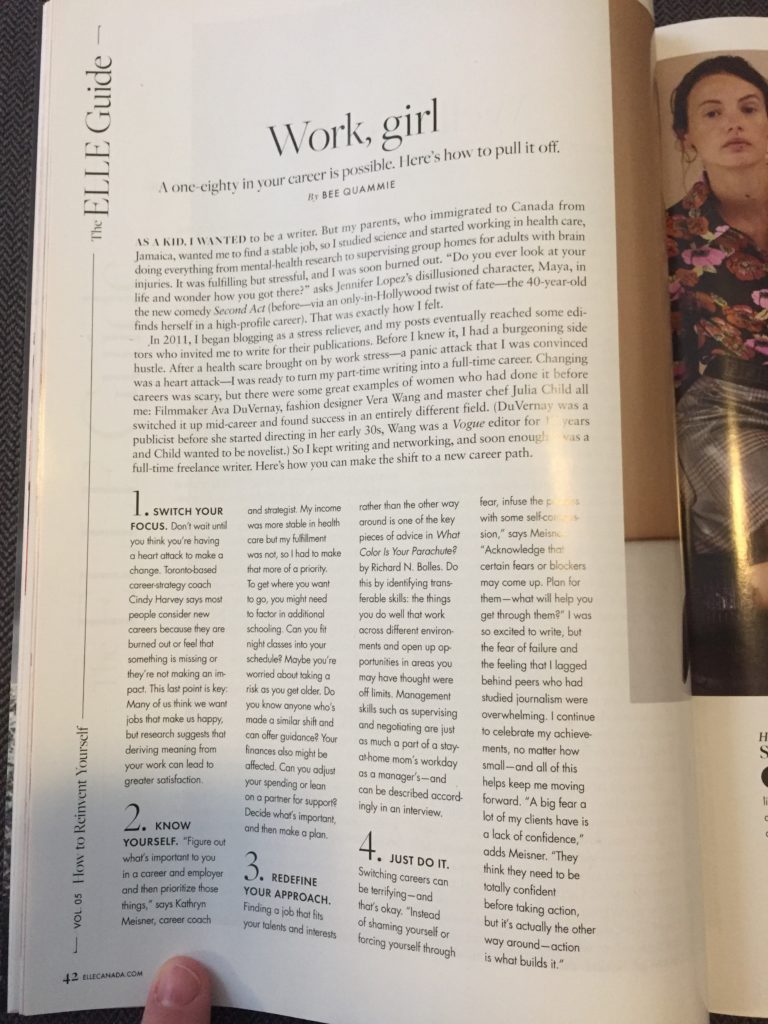
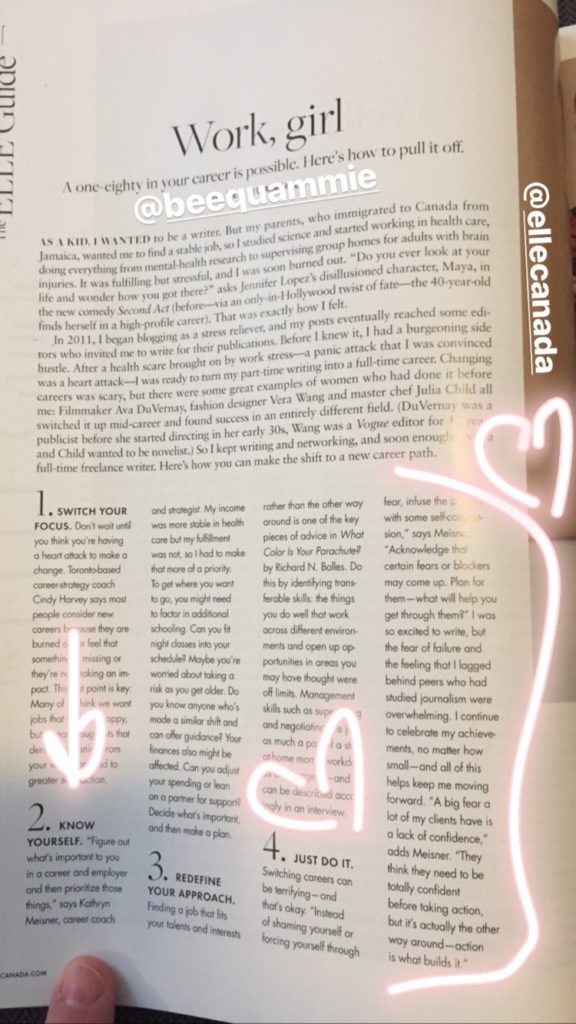
If you’re thinking about job searching or changing careers, check out the advice I gave to Elle Canada’s 1.8 million readers.
Bee Quammie wrote about her experience switching careers and I shared some key advice about job searching, figuring out which job is right for you and how to build confidence.
Yes this is an actual physical magazine.
And yes, I may have bought a few copies…

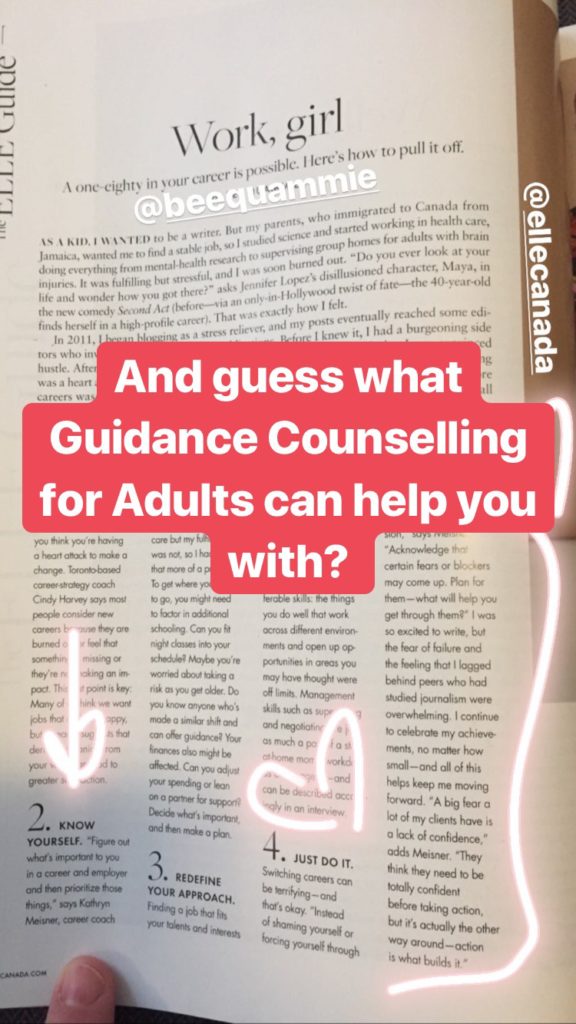
Guidance Counselling for Adults is my 5 week online program to help you figure out the next step in your career and then job search (without relying on resumes).
This is the same process that has helped my clients land their ideal jobs with salary increases of over $50,000.

There are lots of options for personal support from me depending on how much help and accountability you want.
GCA options range from co-working sessions to homework review (I give you feedback on things like your elevator pitch) to a 1:1 session with me.
Guidance Counselling for Adults is now open.
UPDATE: Guidance Counselling for Adults closes on Monday, November 4th at 4pm EST.
I only facilitate GCA 2-3 times a year.
Only 20 11 spots left for the GCA: Intensive.
Th 5 minute strategy I cover in the video above is part of the NEW way to job search which is the focus of Guidance Counselling for Adults.
This is the same process that has helped my clients land their ideal jobs with salary increases of over $50,000.
In GCA, we’ll work together for 5 weeks to figure out your priorities, frame your experience (even if you’ve had a non-linear career), and use the NEW way to job search and explore careers/orgs simultaneously.
All without resumes or gross networking ♥️
*Sliding scale available.
For more info and to see the available sliding scale, click here.
Questions? Use my new fancy website chat or email me at kathryn@kathrynmeisner.com.
What’s the core strategy behind figuring out the next step in your career?
In an earlier blog post, I talked about how The Old Way to job search is broken (yet it’s still what most people do).
Now it’s necessary to shift to a new, more effective way (that also allows you to explore new careers AT THE SAME TIME). You can read more about this here.
In this blog post, you’ll learn the core strategy for The NEW Way to Job
And as an extra bonus, you’ll also learn about the four building blocks you need to have ready before you start.
Let’s pause for a second. I want to tell you what’s happening this Tuesday, October 15th – as in 4 days from now.
It actually makes me feel like a kid before the first day of school – excited to meet a bunch of new people but also nervous (yup, I liked school).
Guidance Counselling for Adults is my 5 week program where you’ll figure out the next step in your career, without relying on resumes or gross networking.
In GCA, you’ll figure out what’s important to you, prioritize what you want, identify your skills, and learn how to confidently market yourself in a way that feels good for you.
You’ll use The NEW Way to Job Search to create (and start implementing) your action plan.
Registration opens this Tuesday. For all you Canadians, that’s the day after Thanksgiving Monday.
Save $100 when you register by Sunday, October 20th at 8pm EST.
Check out Guidance Counselling for Adults here.
If you want help figuring your next step or doing any of the things outlined in this blog post, GCA may be a good fit. The next time I’ll run GCA will be 2020.
Remind yourself about GCA by adding it to your calendar with one click.
This may seem off topic but it’s not. Policies impact jobs and opportunities (among a million other things).
Please PLEASE go vote. You can vote in advance polls now or go vote on Monday, October 21st.
You can vote even if you don’t have a voter card or the right ID – see below!


Scrolling through online postings and then sending resume after resume👏🏼is👏🏼not👏🏼the👏🏼best👏🏼way to land a job or switch careers .
The approach I can help you with – The NEW Way to Job Search – is way more effective and doesn’t rely on resumes (this is a big focus of Guidance Counselling for Adults btw).


The above diagram is a high level summary of my approach – instead of scrolling through online job postings and submitting resumes…
Focus on getting referred or connected to job opportunities.
Remember, there are two main parts to figuring out your next step:
This core strategy helps you do both.
At the core of this two-pronged strategy is talking to other people and tapping into their brain trust.
You can figure out both parts of your next step by applying the same strategy: Talking to other people.
Or, as I like to call it, “coffee chats.”
Through coffee chats, you leverage other people as human search engines and human LinkedIns to help you determine the WHAT and the HOW of figuring out your next step.
It seems simple but it’s elite-athlete-kind-of-simple—when someone is so prepared and practiced that they make it look easy and powerful, but really it takes a lot of time, effort, and training to make it work.
It’s the same with coffee chats…
To do it effectively and not embarrass yourself or waste your time, there’s a ton of work that needs to be done beforehand. I’d like to help you avoid getting stuck or making the mistakes I’ve seen other people make (more on that soon).
Awesome! If they weren’t very effective or didn’t work for you (or maybe you’ve been on the receiving end of a bad one)—keep reading.
I’m going to teach you several key strategies that can drastically improve your coffee chat game.
We’ll get into the four building blocks of figuring out your next step later on in this blog post but first let’s talk about the elephant in the room.
YES!
If you take anything away from this post, please let it be this.
Coffee chats are incredibly powerful and effective for nine main reasons:
Let’s dive in…
You never know when you may need a new job due to a layoff, your job becoming obsolete, or a change in lifestyle is needed (like having kids or taking care of aging parents).
With coffee chats, you can build your network and keep your options open. It’s as close as you can get for preparing yourself for something that you can never totally prepare for.
We’ve all heard the scary stats that say people will now have to change careers many times throughout their lives.
And sometimes, you may just want a new job because you’d like to feel more engaged or want to make more money (job-hopping is the best way to get an increase in salary—not just a small one but a big jump like $55k, which I’ve helped my clients have accomplished).
The great news is that if you learn this skill now, it will serve you for the rest of your life.
That’s why coffee chats are like career insurance.
And if you’re like me and hate feeling trapped in a job, the insights and connections you build up through coffee chats are like having an escape plan in your back pocket.
If you’re coffee chatting often (when I was in my last job, I was doing it 2-4 times a month), it is very possible to land a job before you even leave your current job.
That means you get to avoid the job search altogether.
When you use coffee chats, people connect the dots for you about WHAT your next step is and and HOW you can get there (and ideally, they’ll help you land the job).
When you take action and talk to an actual human instead of continually Googling or just thinking about what you should do next, the contact can share their ideas about which roles or organizations might utilize your skills.
This is HUGE! This is where the person starts to figure out your next step for you.
Do you know every job that’s out there? No. And I don’t either. Often, job titles don’t even really give us insight into what the job actually IS.
Organizational culture is often a reason people stay with or leave an employer. Maybe you’ve been burned by this before? I know I definitely have.
But how do you know what an organization or company is actually like without working there?
By tapping into other people’s brain trust you get a different perspective on your skills and get insights into other fields, jobs, and organizational cultures.
Another way people can connect the dots for you is that they can share job search strategies that have worked for them.
They can also share job postings (people prefer to hire through referrals).
NOTE: This is not the same as just applying to an online posting. When a contact sends you a job posting, it usually means they have some influence and can either refer you as the best candidate (yay!) or at the very least, can get your resume to the top of the pile.
3. YOU get to choose how to frame your experience by leading with your skills, not titles
We. Are. Not. Our. Job. Titles.
Have any of your job titles totally represented ALLLL of what you’ve done in that job? Probably not.
Our lives are not just our jobs, either. We have lives outside of jobs (at least I hope you do).
That means that experience outside of a job is exactly that—experience.
Regardless of where your experience is from—school, volunteering, a personal project, etc.—those skills are still part of the value you will bring into your next job.
Resumes restrict our experience to a narrow 1-2 pages of chronological employment experience.
Gaps in employment stand out.
Employers won’t spend the time to connect the dots between a wide range of experience and skills.
When you figure out your next step by talking to humans, YOU get to lead with your skills and experience, not your titles (unless it supports your experience, in which case, that’s great).
YOU get to craft the story of your experience and connect the dots in the way you want to.
YOU are more than a resume and this strategy recognizes that.
Remember that the person you’re having a coffee chat with is much more than their current job—they usually have had several jobs (or careers!) prior to their current one.
You can learn a lot about what your next step could be and how to get there by learning about their career path and how they ended up in their current job.
Even if you’re not totally interested in their current job, you can gain insights about their previous roles and employers.
People can also give you valuable insights into how to get hired at their organization or the ones they’ve worked at previously.
Resumes can’t do this.
All you usually have to work with is a job posting that often doesn’t truly represent what the role will entail.
I’ve been on the hiring side and can assure you that job postings can sometimes be sloppily thrown together due to time constraints or lack of knowledge (it’s not always an HR person putting it together).
It can get depressing when you’re sending out resumes and not getting much response.
It doesn’t necessarily mean that you’re unqualified, the employer probably just has someone who has already been referred as the best candidate (see the pattern here?).
Your resume may not have even had a chance.
When you actually talk to a human it can show you that, yes, finding a job is possible. And it’s extra amazing when you really hit it off with the person.
Coffee chat contacts can share what the day-to-day life of a particular job or career is like. Do not underestimate this.
`1111I’ve found that people often overlook what the nuts-and-bolts of an actual day are like in a job. I have even overlooked this myself…
I’m actually a trained elementary school teacher (one of my many previous career chameleon lives) but I didn’t pursue it after getting my education degree.
Although I love helping people develop their potential, halfway through my teaching degree I realized that the the day-to-day of teaching didn’t allow me to do enough of that.
When you know what a particular job involves, you can make an informed choice whether to pursue it or not.
This strategy also saves you time because you don’t have to spend hours upon hours of editing and sending out resumes.
It breaks my heart when people decide to go to school (or back to school as the case may be) because they think it will help them figure out their next step and land a job. I just hear the sound of money going down the drain.
Let me be clear: I don’t hate education.
I believe that education is a business that doesn’t always give us the results we expect.
Do you truly need to go school for a particular job?
Will a specific program or degree give you the skills you want?
Are you going to school because you’re hoping it will give you answers?
Or provide an escape?
That is a very expensive risk to take. I know this because I paid my own way through my two degrees (Bachelors degree in Psychology & English and Bachelors of Education).
So if you’re going to school, I want you to be sure you’re making an informed choice and going for the right reasons.
And all of the questions above can be answered by—you guessed it—tapping into other people’s brain trust.
You can get access to the network of the people you have coffee chats with. Good people tend to know good people.
If you think about the fact that each person you’re talking to has at least 3 great contacts…That means a lot of great new contacts for you.
You can expand your network in a massive way through coffee chats.
This is incredibly useful if you have a small network, weren’t born into a family that had connections (I definitely was not), or if you’ve just moved or are just starting out.
Coffee chats cut through the noise. When you are leveraging people in this way, you’re talking to a trusted source with lived experience.
This can really help filter out information that is not accurate or useful. When you read something online or in a book, it’s hard to tell if it’s from a trusted source with real experience.
Often, it is someone writing about a popular topic (Careers! Millennials are doomed! There are no jobs!) who doesn’t actually have the real experience.
If Google provides quantity, coffee chats provide quality.
To make coffee chats work for you, you need to get your four building blocks ready:
And guess what? These four building blocks are a major part of what we work on in Guidance Counselling for Adults.
Add it to your calendar with one click.
If you don’t know what’s important to you in a role, organization, work culture, and other areas of employment, it’s very easy to get sucked into whatever role seems slightly interesting.
This is especially important for people who have “shiny object syndrome,” have lower confidence, or have been job searching or unhappy in their job for a while.
Your priorities help you figure out (and filter out) whose brain trusts you want to tap into.
As we’ve already touched on, you are not your job titles or your resume.
When you lead with your experience and the results you’ve achieved by leveraging your skills, it brings the focus to what you have done.
If you have impressive titles that will add to your credibility, reference them as necessary.
Identifying transferable skills requires knowing which skills you WANT to keep using that may be useful in other fields or industries.
That’s right—just because you are good at something or have experience in it doesn’t mean that you have to keep doing it.
This requires diving into all of your current and past experience, which can be tedious if you’ve been working for many years. It’s worth it, though.
If you’re staying in your current field, focus on deciding which skills and strengths you want to share.
Then it becomes a matter of creating a cohesive elevator pitch and key messages about your skills and customizing what you share about your experience based on who you’re talking to.
You don’t have to have an exact job title in mind to start having coffee chats but you do have to narrow it down.
If you’re interested in Human Resources, it doesn’t really make sense to talk to someone in woodworking, you know?
A focus area could be an interest (like cycling), an industry (like tech), an impact (like women’s rights), or a skill (like sales or project management).
A focus area could also be a specific title if you know it (like chemical engineer or computer programmer). These are all real examples from my clients, btw!
You may have multiple focus areas and that’s ok! At one point in my career I had FOUR: project management, facilitation, education, and technology.
Although I’ve been referring to this strategy as “coffee chats,” they are so much more than that and you need to prepare accordingly.
From prepping your key messages, to finding the right people to talk with, to requesting a coffee chat, to tapping into your contacts’ brain trust, to following up and maintaining the relationship…
It doesn’t happen without preparation and practice.
Most people have at least one building block that they feel REALLY comfortable with and at least one building block that makes them nervous.
What about you – which building block feels good and which one feels nerve-wracking for you?
If you want my help with any of this, take a look at what’s included in Guidance Counselling for Adults.
This is my 5 week program with options lots of personalized support from me ranging from co-working sessions to feedback on your strategies and elevator pitch to a 1:1 session with me. It’s like having access to a career coach for 5 weeks.
Guidance Counselling for Adults opens this Tuesday, October 15th.
And when you register Sunday, October 20th at 8pm EST, you’ll save $100 with the early bird rate.
Add it to your calendar with one click.
Yes! They are the key strategy that have helped me become a successful career chameleon, working in a range of industries from non-profit to tech to consulting and landing high-level roles by age 28.
For reference, here is my background:
What I love about these strategies is that I have seen them help people who don’t have access to networks or contacts.
Being raised in a low-income working class family meant that I didn’t have access to contacts through my parents, so I had to learn these strategies as well.
It’s breaking down strategies that many folks who are in positions of power or privilege already know (and they’ve leveraged to get them to that place). It demystifies the hidden job market.
The Job: Director at Tech Company
How I Landed the Job:
The Job: E-learning Consultant at a National Organization
How I Landed the Job:
The Job: Project Coordinator at a Non-profit
How I Landed the Job:
The Job: Account Manager at a Private Consulting Firm
How I Landed the Job:
The Job: Fashion Magazine Stylist
How I Landed the Job:
I had my four building blocks ready.
I was also sowing many seeds, meeting with as many people as I could without knowing which opportunities would bloom.
Did I know that a random tweet would turn into a job? Of course not! But I got into the habit of cultivating every opportunity I could and didn’t dismiss anything or anyone that could act as my human search engine or human LinkedIn.
Does this coffee chat strategy only work for me?
Nope. I’ve seen it work for many of my clients.
I’ve even had a client who wanted to switch from non-profit management to HR recruiting in the tech industry…She turned a 15 minute phone chat into a role that was especially created for her 6 months later!
That example also goes to show that coffee chats don’t have to be in person and can help you change industries.
After I’ve shared this deceivingly simple strategy, some folks will go out and try applying it right away.
Do not start coffee chats yet.
I still want to cover coffee chat mistakes to avoid so just wait a bit.
The 6 things that I’ve seen prevent people from coffee chatting confidently and successfully.
Guidance Counselling for Adults opens this Tuesday
There will be 3 ways to go through this 5 week career coaching program (with options for lots of personal support from me like a 30 minute one-on-one coaching session with me).
As usual, there will be an early bird price (save $100 when you register by Sunday, October 20th at 8pm EST) and a sliding scale.
Want to know more? Check out Guidance Counselling for Adults here.
The next time I’ll run GCA will be in 2020.
Take care,
Kathryn
PS: If you want my help with any of the strategies outlined in this blog post, Guidance Counselling for Adults is probably for you. Registration opens on THIS Tuesday, October 15th with 3 levels of varying support from me ranging from co-working sessions to a 1:1 session with me. Save $100 by registering in the first few days. Don’t miss the early bird price – add the date to your calendar with one click.
PPS: Blog post summary: Coffee chats can help you job search, explore careers, and find the job that’s right for you but you have to have your four building blocks in place. 1) Establish your priorities. 2) Know how to frame your experience & identify your transferable skills 3) Focus area(s) 4) Prepare & practice.
PPPS: If you learned something from this blog post, I’d be honoured if you shared this blog post with friends or shared it on social media. Thank you!
Are you at work right now? Or on your way there?
Maybe you’re commuting home?
Regardless, take a second to check in with yourself.
Seriously – lower your shoulders, relax your jaw, and take a deep breath (writing that just made me do all those things).
How are you feeling today?
More specifically, how are you feeling about your job today?
If you’re feeling super-fulfilled, valued by your boss, well-compensated, and like you have a clear career plan – yay! You can stop reading right here.
I want everyone to feel this way about their job but you probably don’t need the strategies I’m going to outline below.
And if you don’t feel so great about your work situation and you’re wondering what you should do?
This is for you.
Working with hundreds of clients has highlighted a few patterns. If you’re at the point where you’re thinking about your next step, it’s often because:
A) You’re unhappy at your job
B) (Re-)entering the workforce (hi, grads, moms on mat leave, and stay-at-home parents)
C) You’ve been job searching for a long time already
D) You’re in some other equally stressful and panicked situation
It might also be because you’re bored or want to level-up your career with a new challenge (this can be stress-inducing because you’re not using your strengths or feeling engaged).
Regardless of the reason why you’ve been thinking about figuring out your next step…
I have some great news for you:
And you can stop with the all the resumes and the scrolling through online job postings.
Those strategies are almost always a waste of time and effort. Plus, it just feels painful and soul-crushing.
(As I wrote this, I heard that old GI PSA spoof from Ebaum’s world in the early aughts, STOP ALL THE DOWNLOADING! Fun fact: That video was made 16 years ago and is one of the first pieces of content on the web to go viral).
As a Career & Salary Negotiation Coach, it makes my heart hurt to see people focusing all their efforts on resumes and online postings.
Those strategies used to work – that’s the Old Way to job search. But as you’ve probably realized, things have changed.
The Old Way to Job Search isn’t very effective, especially if:
Plus, the Old Way to Job Search does absolutely nothing to help you get career clarity or figure out which job or organization is right for you.
People who take Guidance Counselling for Adults usually fit into one of the above categories.
This is one of the reasons why I make it an option to join a Guidance Counselling for Adults private Facebook group. People find it so relieving to know they’re not the only one feeling this way.
The OTHER reason why I provide the GCA Facebook group as an option? It’s a great way for ppl to ask me questions and get almost instant answers 😉
And just FYI, Guidance Counselling for Adults opens for registration on Tuesday, October 15th.
If you’re Canadian, that’s the day after Thanksgiving Monday.
If you’re feeling unhappy in your job – even if you’re just feeling like it’s great on paper but something’s missing – I want to make sure you’re taking strategic action that’ll give you RESULTS.
And if you’ve read this far, that probably means you’ve already spent a lot of time figuring out what’s next for you.
You’ve read a million blog posts about finding your dream job. You’ve watched TED Talks about following your passion. Maybe you’ve even read books like, “What Color is Your Parachute” or “Lean In.”
All in search of an exact title to pursue or the perfect dream job but…No luck.
This approach is frustrating, confusing, and exhausting. You may have learned about more career options, but it’s information overload and the choices are paralyzing.
Plus, it leaves you in a bit of a catch-22 situation – how do you apply for a job if you don’t even know *which* job you want? Or what your skills are? Or how to market yourself?
You’re determined to make some (or any) progress, so you scroll through job boards and edit resumes and cover letters until your eyeballs feel like they are going to fall out of your head.
The result? Hours spent hunched over a computer with very little to show for it, except for a few stock responses thanking you for applying and stating only qualified candidates will be contacted for interviews (no phone calls please).
And even if you do get contacted for an interview…
How do you know if the job will actually be what you want? What if the organization/colleagues/your boss is everything you hate? And what if it’s worse than your current situation? WHAT IF YOU DON’T LIKE IT?
Stop waiting until you find the exact job title to go after – so many great opportunities are passing you by while you wait.
Stop applying to online postings – you’re only one of hundreds (or thousands 😬) of applicants and your resume is not the best representation of your experience or transferable skills.
Instead of figuring out your next step using The Old Way to Job Search, start using the strategies I’ve cleverly titled, “The NEW Way to Job Search”.
The goal?
With The New Way, you focus on getting referred or connected to job opportunities.
The New Way makes sure your resume is at the top of the pile.
The New Way implements strategies so that by the time your resume is submitted, it’s really only a formality – an HR detail, because the employer already knows you’re the right person for the job.
Let me unpack this…
There are TWO parts of figuring out your next step (and they can happen simultaneously):
Yes, the end goal is to get referred or connected to a job, but the career exploration happens as you go through the process of accomplishing this goal.
You start by finding out what your priorities are (this helps with decision-making – no more analysis paralysis.
Then, you lead with your transferable skills and experience and leverage people as human search engines and human LinkedIns.
I’ll dive into this approach more in my next email but here’s a bit of a preview:

Let me be honest…
The New Way involves a lot of work. But it’s work that’s intentional, streamlined, and sustainable.
Does applying for job postings with resumes sometimes work? Of course. But it’s draining, ineffective, and very difficult to get any insight into whether the job, organization, or field is right for you.
And searching through job postings and editing resumes is very, very, boring.
With The New Way, you spend less time on career exploration and job searching with more effective results.
If this sounds overwhelming, don’t worry – that’s why I do what I do.
If you’re thinking this, that’s actually a good thing. These strategies can often seem difficult because they’re new and unfamiliar. It definitely does take guts to go out of your comfort zone and try something new.
By actually following through on these strategies, you’re ahead of 99% of other people.
Most people give up easily – use this to your advantage.
In my experience, these new career exploration and job search strategies are not much more difficult than writing resumes and applying to a ton of online postings.
Remember, you’re not in this alone. There is a human on the other side of this email (me!) and I’d love to hear your thoughts on two things…
1. What has been your biggest challenge with figuring out your next step and job searching?
2. How would figuring out your next step make your life better?
Email me at kathryn@kathrynmeisner.com and send me your response.
PS: If you learned something from this blog post, I’d love if you could share this blog post with friends or on social media. Thank you!
PPS: Guidance Counselling for Adults registration opens on Tuesday, October 15th! Add to Calendar