Kathryn Meisner

Career & Salary Negotiation Coach

  • Start here
  • My feminist business practices
  • Blog
  • Results
  • Contact
  • Work with me
    • Guidance Counselling for Adults
    • On-demand courses
    • Free resources
  • Guidance Counselling for Adults

Globe and Mail: I found out my co-worker is getting paid more than me. What should I say to my boss?

By Kathryn Meisner

Since this article is behind a paywall, I’m sharing it here (with permission from the author and the Globe and Mail).

Click here to read this article by Andrea Yu on the Globe and Mail website.

I found out my co-worker is getting paid more than me. What should I say to my boss

If you need support with negotiating or asking for a raise, check out Ask for More, my self-directed online course.

Filed Under: Career Advice, Changing careers, Guidance Counselling for Adults, Job search, Tips and tricks

Career grief & how to deal with it

By Kathryn Meisner

My job was great on paper.

I had translated a liberal arts degree and a range of generalist skills into a Director-level role at a tech company by age 28.

And yes, I used many of the strategies I teach in Guidance Counselling for Adults
.

Back to my seemingly “great job”…


I worked at the kind of place that had beer kegs in the office and where company retreats included performances from big name musicians. 
The money was great, and I got to travel North America and Europe, staying in fancy hotels, eating amazing food, and drinking fantastic wine.
 
And I was a woman in the tech world! This was something I was very proud of.
 
But somewhere along the line, what was important to me changed.
 
I didn’t really realize it because I was always hustling and didn’t have time to stop and think about what I wanted.
 
I was also probably burnt out.
 
I had internalized the typical definition of “success,” without examining what my personal definition was. At one point, I had known what I wanted. I had known what was important to me, what engaged me and gave me flow.
 
I used to know all of these things.
 
But as life changed for me and as I changed (and grew) the job stayed the same.
 
My priorities had changed but I didn’t realize it so I couldn’t align my job to what was important to me.

Career grief

I didn’t realize it but I was grieving my career. What was, what could have been, what I felt SHOULD have been.
 
For me, mourning my career meant I was also grieving my identity.
 
You might not relate to this (or maybe you do?) but I used to look at my job as an expression of myself, a place where I can get engagement and exercise my strengths. I still have this perspective but back then it was unhealthy.
 
When my job was broken, so was I.
 
Or at least that’s how I felt.
 

I FEEL my feelings

I’m an empath, a highly-sensitive person, and an introvert. I’m a Cancer sun, Virgo rising, and a Capricorn moon.
 
So I really FEEL my feelings. And I can have some big ones.
 
I also got diagnosed with ADHD this past spring. Which as a woman, is something that’s suuuper under diagnosed especially if you don’t have the outwardly visible symptoms of the hyperactive type (which I don’t).
 
PSA: The name “Attention Deficit Hyperactive Disorder” is not an accurate representation of what ADHD is. There is no deficit of attention, it’s a DISREGULATION of attention.
 
Maybe I’ll share more about this later? Feel free to ask me about this or reach out if this resonates.
 
I mention all of this to say: I really FEEL my feelings and I can have some big ones.
 
And because my feelings can influence my thoughts and actions, my job situation would inevitably impact my mental health and other things in my life (relationships, self-care, community care – pretty much all the things that are important to me).
 

You can have career grief more than once

You can go through career grief (or job grief, as the case may be) more than once in your career btw.
 
I’m a career chameleon so career grief has already hit me several times. I just didn’t have the language for it then.
 
I’ve held roles in the private, non-profit, charity, and tech sector. I’m even a qualified elementary school teacher. And I had to start the mourning process before I could start figuring out my next step.
 
The more import the job or organization was to me, the more I had to grieve, heal, and work to let it go.
 
The more consciously I grieved my career, the faster I moved through this process.

Integrate grief as part of figuring out your next step.

Grief is usually an ongoing process so you’d be waiting a super long time if you waiting until you were totally done grieving.
 
In my experience, and working with people in Guidance Counselling for Adults, you probably need to spend at least a little time grieving and letting go of your current job (or if you’re unemployed, your last job).
 
In the 10 days of Guidance Counselling for Adults, we’ll not only work on WHAT you can do to figure out the next step in your career but HOW you can do it. And grieving can be integrated into this process..
 
Because if all you needed was more information so you knew WHAT to do, you’d have probably done it by now.
 
Starting to grieve is also important if you’re thinking about leaving a PhD, Masters, or any education program.
 
It’s also important when you’re transitioning back into the workforce (like if you’ve been on mat leave or you’ve been home w your kids). You might be excited to be working again but it’s a transition so it can bring bring up some grief.
 
Career grief can also be identity grief.

Career grief can be like the canary in the coal mine. For me, it can start 
before I even realize it’s time for me to move on.
 
I used to be miserable for months (and one time, for more than a year) before I’d recognize that this was a sign I needed to start figuring out what was next.
 

Marie Kondo your career

If you’ve already realized your needs aren’t being met in your job or your priorities have shifted, take time to celebrate what your old priorities gave you or helped you achieve.
Take time to grieve your old priorities.
 
Marie Kondo your priorities and your job: Thank them for their service and let them go.
 
And then identify and own your new ones.
 
How do you do that? That’s something I work on with clients in Guidance Counselling for Adults.
 
Can we get all of our priorities met? Maybe not.
 
But by KNOWING your priorities and OWNING them, we have a significantly higher chance of getting what we want.
 
Grieving, celebrating, and resilience-building strategies are an incredibly useful but often overlooked strategy to help you find the right job.
 
Working on these things will also help build and maintain motivation throughout your job search and deal with any setbacks or fears you might encounter). This is why I’ve made this part of GCA.
 
What is GCA exactly? 

Guidance Counselling for Adults: Find and land the job (and workplace) that’s right for you – without relying on resumes. 

A 2-week intensive job search strategy & implementation program plus 6 months of coaching, strategy, structure, accountability, and a learning community.

Register here: https://kathrynmeisner.com/gca

10% of revenue will be shared with a Black-led community organization. I’ve committed to this as a part of my anti-racist work as a white, settler woman. Last GCA revenue was shared with Scarborough Mutual Aid.
 
This is *not* an online course where you register and then are on your own.

And if you’ve we’ve worked together before or you don’t need GCA right now, I’d be honoured if you could send this blog post to someone who may be interested.

Guidance Counselling for Adults opens in September but you can apply now to see if we’re a good fit.


Filed Under: Career Advice, Changing careers, Guidance Counselling for Adults, Job search

How to deal with job search procrastination: A Career & Salary Negotiation Coach’s personal strategies

By Kathryn Meisner

Time management and procrastination do not come easily to me. 

This makes doing things I don’t want to do so. much. harder.

As a result, I’ve had to develop a lot of strategies to cope and to work on these things. 

The strategies below are all my personal strategies but they also are strategies that I share with my clients in my one-week intensive, The Pandemic Edition of Guidance Counselling for Adults.

Why? 

Because they can also work for your job search.

What I’ve seen with working over 500 clients over the past few years is that you can know all of the strategies about HOW to job search…

But if you don’t have accountability or a way to deal with procrastination and manage your time, it’s really, really hard to figure out your next step and job search.

The Pomodoro Technique: You can do anything for 25 minutes

If I’m having a really hard time focusing or I don’t want to do something, I use the Pomodoro Technique:

You work for 25 minutes straight and then take a 5 minute break.

Apparently its name relates to the Italian word for tomato, “pomodoro” because it’s based on those tomato kitchen timers things and the kitchen timer (or any timer) is essential to the Pomodoro Technique.

The idea is that you can work on anything – no matter how boring or how hard it is – for 25 minutes.

No distractions, no multi-tasking, no checking your phone. 

Then you take a screen-free break for 5 minutes.

And then you set the alarm for another 25 minutes. 

You do that for a series of four or five rounds and then you take a longer break for 20 or 30 minutes. 

This is actually a strategy I use when I facilitate a coworking session with clients in my one-week intensive, The Pandemic Edition of Guidance Counselling for Adults.

We jump online. Everybody says which GCA homework they’re going to work on during that time. And then we Pomodoro.

If it’s not in the calendar, it’s doesn’t exist

My Google calendar containts my life. 

I’m not a naturally organized person, so I try not to make it too complicated so I don’t get bogged down by the process. 

I have several Google calendars that I share with various people:

  • One for my work
  • One for my family that I share with my husband 
  • One just for me

Sure, sometimes I accidentally add the wrong thing in the wrong calendar but I try give myself permission to be okay with that because getting something in the calendar somehow is better than getting nothing in the calendar. 

I live and die by my calendar. So much so that I even send out calendar invites to friends. 

Because if it’s not in the calendar, it doesn’t happen. 

Time blocking

I time block everything in my calendar. 

Not just dates or that kind of thing.

If I need to do a task, I put it in my calendar for the amount of time that it will take as well as some buffer time as well. 

If I have to go somewhere (well, when I went places before COVID), I’d actually block in the travel time, when I needed to leave, as well as the travel time home. 

I do this for myself but because whoever I’m sharing a calendar with (ie my husband or my assistant), they may need to know how long it’s going to take me to get home or when I’ll be home

Put your phone in another room

I have to find the citation for this but there is research that shows that when you’re touching your phone or have it in your pocket, your brain is constantly staying vigilant looking for an alert. 

This means your phone is taking up some of your attention, even when you can’t see it. 

The solution? 

Put your phone more than one arm’s length away, ideally in another room. And put it on Do Not Disturb so you don’t get any alerts. 

Want to stop procrastinating on finding a better job?

These are just a few of my time management and procrastination strategies, ones that I personally use in my life. 

I’m not a naturally organized person so I have to develop coping mechanisms to help me do things that I don’t want to do or have been procrastinating on.

And if this sounds familiar, these strategies may be useful for you, too. 

They’re also useful for when you’re going through your job search or switching careers.

If you want support – and accountability – with figuring out the next step in your career, check out The Pandemic Edition of Guidance Counselling for Adults and book a time to talk with me.  

Filed Under: Career Advice, Changing careers, Guidance Counselling for Adults, Job search, Tips and tricks, Uncategorized

The career advice I gave to 1.8 million people

By Kathryn Meisner

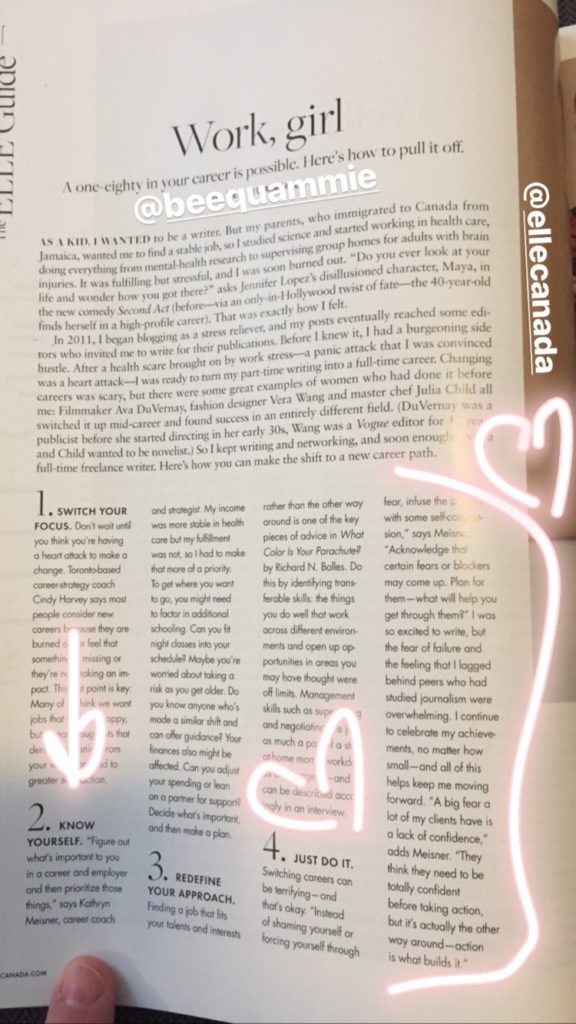
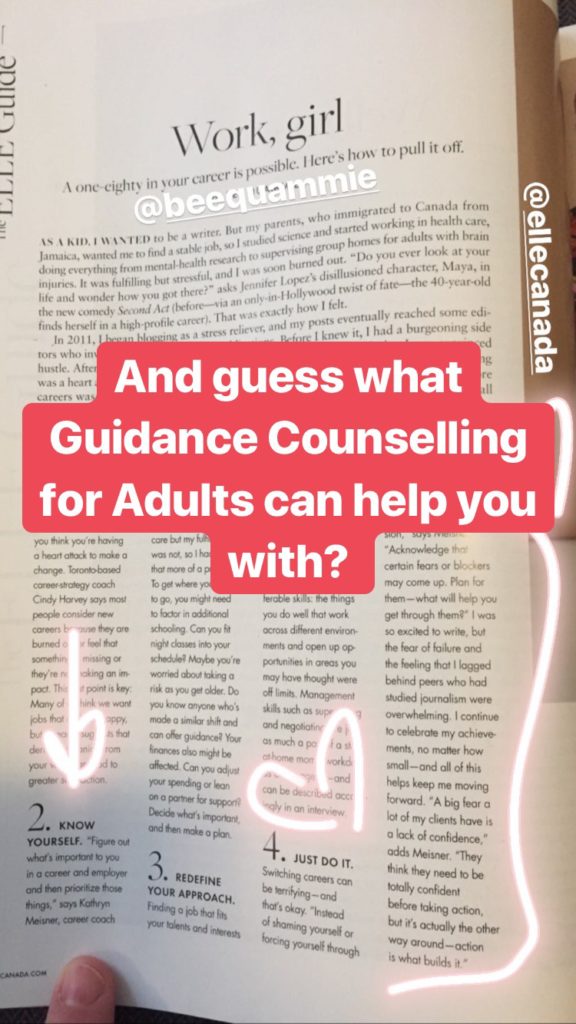
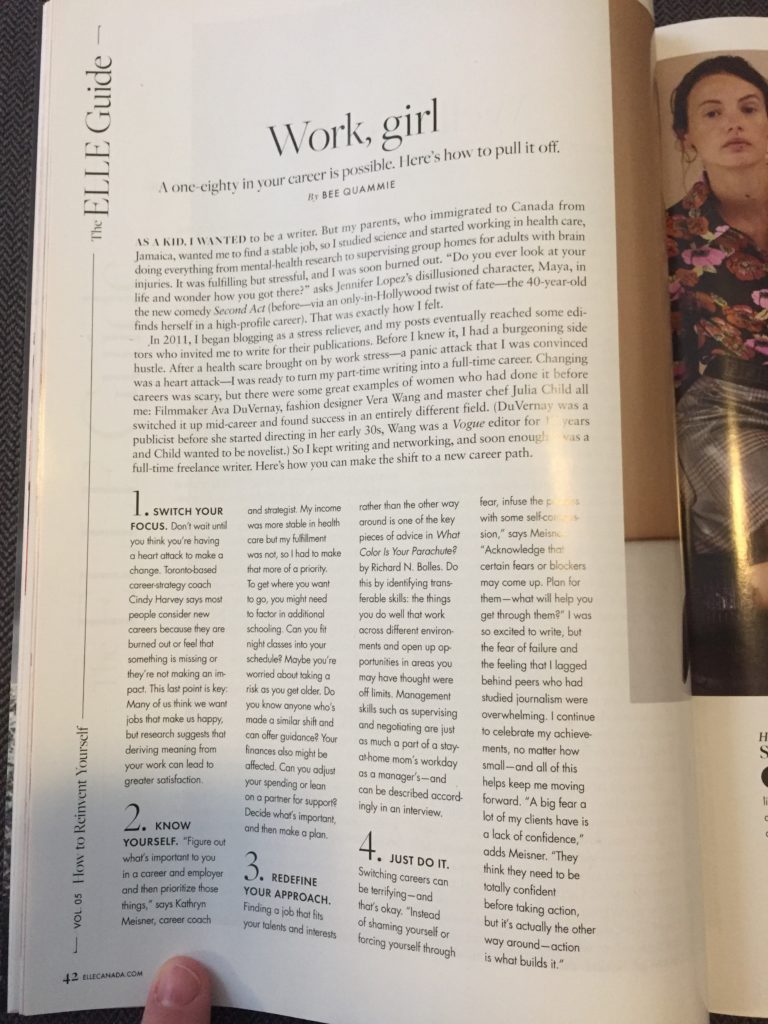
If you’re thinking about job searching or changing careers, check out the advice I gave to Elle Canada’s 1.8 million readers. 

Bee Quammie wrote about her experience switching careers and I shared some key advice about job searching, figuring out which job is right for you and how to build confidence.

Yes this is an actual physical magazine.

And yes, I may have bought a few copies…

What’s Guidance Counselling for Adults?

Guidance Counselling for Adults is my 5 week online program to help you figure out the next step in your career and then job search (without relying on resumes).

This is the same process that has helped my clients land their ideal jobs with salary increases of over $50,000.

There are lots of options for personal support from me depending on how much help and accountability you want.

GCA options range from co-working sessions to homework review (I give you feedback on things like your elevator pitch) to a 1:1 session with me.


Guidance Counselling for Adults

Guidance Counselling for Adults is now open.

UPDATE: Guidance Counselling for Adults closes on Monday, November 4th at 4pm EST.

I only facilitate GCA 2-3 times a year.

Only 20 11 spots left for the GCA: Intensive.

Th 5 minute strategy I cover in the video above is part of the NEW way to job search which is the focus of Guidance Counselling for Adults.

This is the same process that has helped my clients land their ideal jobs with salary increases of over $50,000.

In GCA, we’ll work together for 5 weeks to figure out your priorities, frame your experience (even if you’ve had a non-linear career), and use the NEW way to job search and explore careers/orgs simultaneously. 

All without resumes or gross networking ♥️

*Sliding scale available.

For more info and to see the available sliding scale, click here. 

Questions? Use my new fancy website chat or email me at kathryn@kathrynmeisner.com.

Filed Under: Blog, Career Advice, Changing careers, Guidance Counselling for Adults

5 reasons why I spoke about resilience in my TEDx (now with 100,000+ views!)

By Kathryn Meisner

I did this TEDx on resilience a few years ago because I found resilience to be such a useful skill in my life. Once I recognized that resilience is actually a skill that can be learned, I became super interested in it and really dove into the research. And, as you probably already know, finding and landing the job that’s right for you is hard and requires a TON of resilience. I often get asked why I chose resilience as a topic and here are my top 5 reasons which may also apply to you…


1. My career has not been linear

This is actually a *strength* – not a weakness – as long as I can package it well. I chose a topic that I knew would always be in line with any job I pursued (this was way before I started my career and salary negotiation coaching full-time 4.5 years ago).


2. Since we’ll all change jobs many times in our careers, we need to learn how to figure out our next step…again and again

I was working as a Director at a tech company at the time I did my TEDx on resilience but I knew that I would eventually move on (most of us will change jobs many times through our careers). I didn’t know what my next step would be after my Director role. I actually wasn’t even thinking about it at that point. What I DID know was that I would probably change jobs within 2-3 years (and I was right btw). I strategically chose a topic that I new would be important to me beyond the job I was in at the time and that I could leverage for my personal branding.


3. Things can live on the internet forever – use that to your advantage.

I knew that this video – even if it only got 3 views – would show up on the first page of my Google results search whenever potential employers (or nowadays, potential clients) were doing a Google search. It’s still one of the first things that show up in my search results.


4. Resilience is necessary to figure out the next step in your career – especially if you’re dealing with career grief.

Working with 500+ clients in 13 countries has showed me that resilience is one of the most useful skills to develop in careers (and life). Resilience is also super useful to me, personally. Doing this TEDx was in itself an exercise of resilience. And when 100,000+ end up watching a TEDx about resilience, it tells me that this is a skill that people want. Building your resilience skill can be especially helpful if you’re dealing with career grief.


5. Efficiency!

I’ve shared this research and strategies with so many people over the years that I knew that if I created a video, I could just send people the link. I’m such a nerd, I know.


HOWEVER If I could do this TEDx again…

There’s so much that I would add. Since I can’t update my TEDx, please read the points below before you watch it:

  • I now take more of a systemic view of resilience. At the time, I didn’t fully recognize factors like power, privilege, and systemic racism that can contribute to how easy or how hard it can be for you to build resilience. As a result, this is a big gap in my TEDx because I didn’t raise these issues.
  • Yes, we are all responsible for our own actions AND I believe it’s also important to acknowledge that we exist within an inequitable system.
  • I also now recognize how community and genuine support and encouragement can help us build resilience. It’s easier to figure out your next step when you have someone – or many people – supporting your process (this can also a form of privilege that not everyone has access to).

Please keep these things in mind as you watch.


Thinking about the next step in your career?

I’d love to help you find and land the job (and workplace) that’s right for you with Guidance Counselling for Adults.

In Guidance Counselling for Adults, we’ll work together for 2 weeks (with 6 mths support) to figure out your priorities, frame your experience (even if you’ve had a non-linear career), and use the NEW way to job search and explore careers/orgs simultaneously. All without resumes or gross networking ♥️

GCA is the same process that has helped my clients land their ideal jobs with salary increases of over $50,000.

Click here for more details.

PS: I only facilitate Guidance Counselling for Adults 4-5 times a year so if you want to get working on your next step, check out GCA now.

Filed Under: Career Advice, Changing careers, Guidance Counselling for Adults, Job search, Tips and tricks

  • 1
  • 2
  • 3
  • Next Page »

Copyright Kathryn meisner© 2026