Kathryn Meisner

Career & Salary Negotiation Coach

  • Start here
  • My feminist business practices
  • Blog
  • Results
  • Contact
  • Work with me
    • Guidance Counselling for Adults
    • On-demand courses
    • Free resources
  • Guidance Counselling for Adults

Why it’s time to divorce your job title

By Kathryn Meisner

You don’t need to contort your work history into a linear career. You know more than you think and you have way more to offer than you realize.

I don’t want to help you cover up your non-linear work history, I want to help you discover and confidently communicate the *value* you bring because of it.

Your difference is your differentiator.

I want to help you transform how you see your skills and experience and ultimately, yourself.

This is what happened with the client below and it’s part of you’ll work on in Guidance Counselling for Adults (
registration opens in September but you can apply now to see if we’re a good fit).
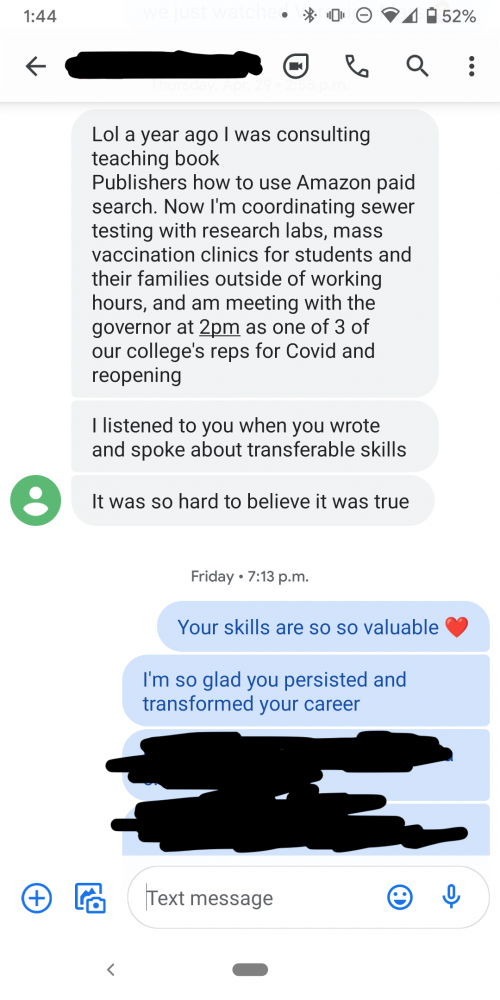
Divorce your job titles

In Guidance Counselling for Adults, you’ll divorce your job titles by unpacking all your roles and detaching your skills out from job titles. Then, we’ll translate them into transferable skills and divorce your job titles.

This is ESPECIALLY important if you’re a generalist or switching careers. My guess is that your titles have never really been an accurate description of what you do. Maybe your current job has expanded past the confines of your official title a while ago?

And if it’s helpful, we can have a “job title divorce party” to help you let go and move on from the titles (and workplaces) that you want to leave behind. Let’s burn it down together.

After that?

A sustainable job search strategy that fits your life.

No job search burnout for you.

One of the many challenges of figuring out the next step in your career and then actually finding that role is that it feels like a full time job, often while you’re already working. And if you’re unemployed, you have to also fend off panic about finances.

We’ll be intentional with a clear strategy, the right tools, the right connections, and the right action. All tailored to your specific context.

You’ll leave behind information overload and analysis paralysis.

You’ll take calculated, strategic risks with strong, steady support behind you (from moi).

You’ll find out what’s possible without actually knowing what’s out there.

You’ll be able to confidently talk about your experience.

Remember guidance counsellors?

Some of us had better experiences with them than others, but basically guidance counsellors helped us (or at least they were supposed to help us) navigate the confusing world of university, college, and careers. They helped us figure out what we were good at, sometimes with surprising results. The best ones helped us stay true to ourselves–our interests, abilities, and desires–and avoid directions that weren’t the right fit.

Why should this kind of guidance end after high school?

I became a Career and Salary Negotiation Coach because every career move takes us into the unknown, and every person deserves a calm, encouraging, and experienced guide. I’ve worked with over 500 people across 13 countries to help them find jobs they love in less time, and with salary increases up to $50,000. Yup, for real.

I’ve been called a career therapist and a salary doula.

I like to think of myself as your caring, warm-hearted, and action-oriented career coach and job search strategist, ready to support you with tools and accountability, and to stick with you through the entire process–from getting clear on what you want all the way through to negotiating your salary.

Want to work together? Apply for GCA (capped at 12 people)

Click here to read about Guidance Counselling for Adults: https://kathrynmeisner.com/gca

Find out how my decade worth of job searching wisdom, experience, lessons, practical tools, and collaborative methods can help you transform how you see your skills and experience, transform your job search, and land the job (and workplace) that’s right for you.

Let’s get the divorce party started.

Take care,

Kathryn

PS: The summary? Divorce your job titles. I’ll help you do this in Guidance Counselling for Adults which opens in September. You can apply now to see if we’re a good fit.
 

Filed Under: Uncategorized

How to deal with job search procrastination: A Career & Salary Negotiation Coach’s personal strategies

By Kathryn Meisner

Time management and procrastination do not come easily to me. 

This makes doing things I don’t want to do so. much. harder.

As a result, I’ve had to develop a lot of strategies to cope and to work on these things. 

The strategies below are all my personal strategies but they also are strategies that I share with my clients in my one-week intensive, The Pandemic Edition of Guidance Counselling for Adults.

Why? 

Because they can also work for your job search.

What I’ve seen with working over 500 clients over the past few years is that you can know all of the strategies about HOW to job search…

But if you don’t have accountability or a way to deal with procrastination and manage your time, it’s really, really hard to figure out your next step and job search.

The Pomodoro Technique: You can do anything for 25 minutes

If I’m having a really hard time focusing or I don’t want to do something, I use the Pomodoro Technique:

You work for 25 minutes straight and then take a 5 minute break.

Apparently its name relates to the Italian word for tomato, “pomodoro” because it’s based on those tomato kitchen timers things and the kitchen timer (or any timer) is essential to the Pomodoro Technique.

The idea is that you can work on anything – no matter how boring or how hard it is – for 25 minutes.

No distractions, no multi-tasking, no checking your phone. 

Then you take a screen-free break for 5 minutes.

And then you set the alarm for another 25 minutes. 

You do that for a series of four or five rounds and then you take a longer break for 20 or 30 minutes. 

This is actually a strategy I use when I facilitate a coworking session with clients in my one-week intensive, The Pandemic Edition of Guidance Counselling for Adults.

We jump online. Everybody says which GCA homework they’re going to work on during that time. And then we Pomodoro.

If it’s not in the calendar, it’s doesn’t exist

My Google calendar containts my life. 

I’m not a naturally organized person, so I try not to make it too complicated so I don’t get bogged down by the process. 

I have several Google calendars that I share with various people:

  • One for my work
  • One for my family that I share with my husband 
  • One just for me

Sure, sometimes I accidentally add the wrong thing in the wrong calendar but I try give myself permission to be okay with that because getting something in the calendar somehow is better than getting nothing in the calendar. 

I live and die by my calendar. So much so that I even send out calendar invites to friends. 

Because if it’s not in the calendar, it doesn’t happen. 

Time blocking

I time block everything in my calendar. 

Not just dates or that kind of thing.

If I need to do a task, I put it in my calendar for the amount of time that it will take as well as some buffer time as well. 

If I have to go somewhere (well, when I went places before COVID), I’d actually block in the travel time, when I needed to leave, as well as the travel time home. 

I do this for myself but because whoever I’m sharing a calendar with (ie my husband or my assistant), they may need to know how long it’s going to take me to get home or when I’ll be home

Put your phone in another room

I have to find the citation for this but there is research that shows that when you’re touching your phone or have it in your pocket, your brain is constantly staying vigilant looking for an alert. 

This means your phone is taking up some of your attention, even when you can’t see it. 

The solution? 

Put your phone more than one arm’s length away, ideally in another room. And put it on Do Not Disturb so you don’t get any alerts. 

Want to stop procrastinating on finding a better job?

These are just a few of my time management and procrastination strategies, ones that I personally use in my life. 

I’m not a naturally organized person so I have to develop coping mechanisms to help me do things that I don’t want to do or have been procrastinating on.

And if this sounds familiar, these strategies may be useful for you, too. 

They’re also useful for when you’re going through your job search or switching careers.

If you want support – and accountability – with figuring out the next step in your career, check out The Pandemic Edition of Guidance Counselling for Adults and book a time to talk with me.  

Filed Under: Career Advice, Changing careers, Guidance Counselling for Adults, Job search, Tips and tricks, Uncategorized

LinkedIn Tips: How to update your LinkedIn without notifying your connections + 2 other stealth moves

By Kathryn Meisner

For those times when you need to make some changes to your LinkedIn profile…

And you don’t want anyone to know.


Filed Under: Uncategorized

My birth & babies resource list: From the best baby gear to PPD & ADHD

By Kathryn Meisner

A list of things, resources, and advice I’ve found to be helpful for new moms with some extra bits about my own experience with post-partum depression (PPD), post-partum anxiety (PPA), and getting diagnosed with ADHD at 11 months after giving birth (skip straight to #7 for PPD + PPA stuff and #10 for ADHD).

Your mileage may vary – some of these tips and resources may be super helpful, some may not.

And that is totally ok – do what’s best for you.

Also – if it’s not clear from this post, I truly do believe that “what’s best for mom, is best for baby.”

***Please note: This is a work-in-progress so the formatting and copy may be a bit wacky***

I researched and gathered A TON of resources before and after Astrid was born.

I absolutely LOVE to share resources – this passion is not limited to my role as Career & Salary Negotiation Coach) so I often end up sharing these resources with expecting or new parents.

I’ve been keeping lists of links and resources. A few in Google docs. A few in my phone. Some in emails.

Today I decided to put them all in once place.

So here they are! I’ll be adding to them as I can. Please feel free to share with whomever needs them.

And if you’re sharing with an expecting mom or new mom who has a man for a partner, please share with him as well. Hopefully this can help balance the invisible and emotional labour that comes with motherhood.


Here’s what’s included (so far)

  1. The best baby gear & best registry site (for us)
  2. Some things I’ve learned so far that may be helpful…
  3. Organize a meal train (use this app to help with boundaries)
  4. Make padsicles or have a “padsicle party” (recipe included)
  5. Make energy balls (my favourite recipe included)
  6. How to help your baby sleep without using “cry-it-out” (CIO)
  7. Post-partum depression (PPD) & post-partum anxiety (PPA): Not just for new moms
  8. My experience with post-partum depression & anxiety (PPD & PPA)
  9. How I survived post-partum depression & anxiety (PPD & PPA)
  10. My ADHD diagnoisis
  11. Extra thoughts

1. The best baby gear & best registry site (for us)

Here’s the stuff we’ve found most useful (I’ve kept this registry updated based on what actually was helpful) https://www.babylist.com/kathrynanderic


2. Some things I’ve learned so far that may be helpful…

-before birth, read at least half of “The happiest baby on the block” – great strategies about how to learn to soothe a baby and get them to sleep

-Have both of you check out “The Birth Partner” book – wish I had read it earlier!

-Acupuncture is amazing to reduce pregnancy swelling and to induce labour (but make sure your cervix has thinned enough or else it will start labour before you’re body is ready)

-Check out the site, Spinning Babies to see the various exercises you can do before birth to help baby drop and get into the right position

-Make (or have someone else make) padsickles before birth (just google for a recipe)

-During labour, I found it helpful to talk to my body and say things like, “you’re doing a great job, body”

-Don’t be embarrassed about bringing too much stuff to the hospital – I brought 4 big bags (including knee pads!)

-If breastfeeding is painful, see a lactation consultant ASAP. It shouldn’t be very painful and pain should only last for the first 15-30 seconds of feeding. Midwives and doctor’s are not well versed in lactation so that’s why I recommend seeing a consultant.

-I’d even suggest having a consultant come to the hospital ASAP after birth – they do this!

-Breastfeeding should only take 40 mins max, of longer, see a consultant

-If the baby isn’t “milk drunk” after feeding, see a consultant (usually means not getting enough)

-There is no shame in using formula to supplement or as a full replacement

-Make sure your baby is checked for a tongue tie at the hospital

-If possible, have dad sleep as much as possible during the night. Have one person rested is better than having two exhausted parents

-Debrief your birth and timeline of the birth with your care provider or doula. This can help bring some closure or reduce trauma

-Babies make weird grunting sounds when they sleep

-Using the Boba wrap or something similar will give you free hands (you can use it at 1 week I think)

-It’s ok to not have ppl over for the first few weeks – I only have ppl over who I was ok seeing me topless

-after the first few days, Try to get 6-7 hours sleep over the day. If you’re not getting it, get more help

-let your baby be on the floor as much as possible, ideally under a play yard. This sounds weird but it’s super helpful for their development bc they can move around more

-babies are naturally curious – you don’t need to entertain them all the time. Let them explore things and don’t interrupt them, if possible. This helps them learn to focus and self- entertain.

-keep track of number of pees and poops per day until about 6 or 8 weeks. Your care provider will tell you this cut we didn’t realize how important it was so we didn’t donit for the first few days lol

-Take soooo many pics and VIDEOS in the first few weeks – I legit don’t remember much from that time

-It’s ok to not like your baby or like being a mom. It will come.

-Go out and do things and see ppl as much as you can in the first 3 months (once you’re healed and up for it of course!) – babies don’t really need a routine or specific bedtime until about 3-4 months. At that point, i found we really needed to be home for some naps and a certain bedtime.

-Swaddle the baby whenever they sleep

-For the first few weeks, there’s a “witching hour” that starts around 4pm and can go til 11pm – basically the baby cries for no reason but this is normal

-Cluster feeding is real – this is when the baby feeds for several hours straight or with short breaks in between. This is when they’re going through a growth spurt but shouldn’t be happening all the time.

-Get Dad to be as independent as possible with the baby as soon as possible – able to soothe and take care of babe on his own. It’s so easy for this to not happen bc mom and grandmoms often take on so much of the work by default. It helped me to have Eric take Astrid for a walk while I was sleeping during the day. Then I couldn’t hear her cries

-Ask for help! Even if it’s just texting ppl questions, it’s so useful

-Baby advice is like travel advice – everyone has their opinion but only listen to the advice of ppl who share the same values as approach as you guys


3. Organize a meal train (use this app to help with boundaries)

-Have someone organize a meal train/food delivery/food gift cards with this app https://www.mealtrain.com/ (note that you can put any boundaries around this that you want. I said things like “Drop off the food but no visits at this point”)

-People will want to help you after birth, mostly with food so having a way to funnel people’s generosity can make it easier for you AND them.

-I found I wasn’t ready for it until about a month after Astrid was born so (ideally before birth,) tell the person who’s organizing it that you’ll text them when you’re ready for food

-This app allows you to choose when you want food and how you want it to be dropped off (at the door or visits welcome etc). It also allows you to tell ppl where you want delivery and gift cards from

-You just tell the organizer who you want on the list and your preferences and restrictions and they do all the admin.

-You get access to the app just to see who is dropping off what when. I found having food dropped off ever 2-3 days was helpful


4. Make padsicles or have a “padsicle party” (recipe included)

-Make them or have someone make them BEFORE birth. You can even have a padsicle party. 

-Recipe: https://minutewithmary.com/2013/05/padsicles-new-moms-perfect-companion.html

-Shopping list: Purchase the largest most extreme padded sanitary pads that you can find (here’s a pic of the ones I like https://drive.google.com/file/d/0B0T2ImQti4XmelBiaUlCdUUtODNORlFjUUZTemxPazVrQXNn/view?usp=sharing) . Also, pick up some aloe vera, witch hazel,, and a box of gallon freezer bags.


5. Make energy balls (my favourite recipe included)

-Make them or have someone make them BEFORE birth

-No-Bake Energy Balls (http://www.gimmesomeoven.com/no-bake-energy-bites/)

-I ate these daily for literally the first 6 months postpartum, sometimes as a whole meal – the flax and chia seeds help them be nice and filling/nutritious. -I would freeze a whole batch at a time (layered with wax paper between) and just eat them straight from the freezer. One time I made a variation with almond butter instead of peanut butter, and white chocolate & dried cranberries instead of chocolate chips, and that was absolutely delicious too.


6. How to help your baby sleep without using “cry-it-out” (CIO)

Some of my favourite resources (check these out before you give birth so that you can learn them before you’re sleep deprived):

–https://www.happiestbaby.com/blogs/baby/the-5-s-s-for-soothing-babies (and the book)

–https://babysbestsleep.com/slumberparty/ the podcast (she interviewed Emily Oster!), her IG, her FB lives, and her services

–https://www.instagram.com/p/BjeuGjoFQOw/ for sleep/wake windows for newborns to 3 years

–https://www.instagram.com/p/BjUa6k5DaZU/ this newborn sleep tip and the following 3 or 4 posts


7. Post-partum depression (PPD) & post-partum anxiety (PPA): Not just for new moms

Fun fact: PPD and PPA can happen anywhere up to 1 year post-partum. And it can be triggered by weaning or stopping breastfeeding.


8. My experience with post-partum depression & anxiety (PPD & PPA)

At 4 months after Astrid was born, I had severe post-partum anxiety which turned into depression. WIthin a week I had an appt with my psychiatrist.


9. How I survived post-partum depression & anxiety (PPD & PPA)

This is the program at Women’s College Hospital that I was referred to  https://www.womenscollegehospital.ca/care-programs/mental-health/RLS/ (you need a referral from your dr). There can be a waitlist so if you’re in crisis, don’t minimize your symptoms to your family doctor.

A nurse from women’s college will call you once you’re referred – make sure you’re very clear about your symptoms so they can get you support fast.


10. My ADHD diagnosis + resources

I’m so so so grateful for the Women’s College Hospital program (legit tearing up right now w gratitude) bc it was my lovely therapist who recommended that I get tested for ADHD.

The assessment usually costs $2k+ but since I was in the program, I got tested by a psychiatrist there and yup, I have ADHD (the inattentive kind, not the hyperactive kind). Another fun fact: ADHD tends to show up for women as they take on more responsibilities in life like moving in with a partner, getting a bigger job, and HAVING A KID. https://www.theatlantic.com/health/archive/2013/04/adhd-is-different-for-women/381158/. 

I run my own business as a Career & Salary Negotiation Coach (👋 https://kathrynmeisner.com/) so I’ve built my work around my ADHD strengths but holy shit it got worse with having a baby.

Here are some resources that I found to be helpful both before AND after ADHD:

  • Women with ADHD podcast episode with Sari Solden: Falling through the cracks. Solden talks about what undiagnosed girls and women with ADHD go through, how they fall through the cracks, and what you can do if you can relate. Ignore the crappy audio quality!
  • I’ve also just started listening to this podcast, The Healthy ADHD Podcast. There’s some reference to parenting but it applies to everyone.
    • I especially love this episode
    • And this one “Momming with emotional hyperfocus”
  • I also found this short primer to ADHD helpful, especially these parts:
    • “If you’ve got an ADHD/ADD brain, the standard medical treatment is to effectively replace the missing dopamine, and, additionally, monitor your physiological state, train yourself to do things a bit differently to achieve your goals, eat healthy foods, exercise regularly and guard your sleep like it’s Buckingham Palace…
    • “ADHD is a biological (genetic and from birth) and neurological (brain information processing & storage) difference.  Historically, it seems like it has been isolated in the ‘mental health’ corner of health care, likely because the symptoms of untreated ADHD are observable – behaviours that seem out of place with what is expected…
    • “People with ADHD have a lot of cognitive energy to burn every day – knowing how to manage that energy is an essential part of taking care of oneself.  Having ADHD makes it harder to plan, manage time, direct our actions and responses, make decisions about what to do next, and control our emotions. It’s easy to get distracted and to do only the things that our brains think are interesting (which are never ever  paying the bills, opening mail, doing the laundry or turning off lights)…
    • “It becomes critical then, to learn how to do what we need to do, to get where we need to go in life. It’s NOT about forcing our loved ones to ‘fit in’ to a neurotypical world, or changing someone to be more like someone who doesn’t have ADHD.  Treating ADHD doesn’t cure ADHD.  Treating ADHD is like getting a personalized roadmap to your brain – here is how your brain works, and here is how to make the best of it, so you can go do your thing.”
  • I also love this blog and the associated Facebook group, The Untapped Brilliance Club


11. Extra thoughts

I think the most important thing about being a parent is…communicating unconditional love to your kid. 

There is so much we will screw up as parents but everything is fixable if the kid knows they’re unconditionally loved. 

This makes me feel better when I worry if I’m doing it “right”.


Hope this post helps you on your journey!

Filed Under: Uncategorized

Please read: Why I’m cancelling tonight’s workshop at Toronto Public Library

By Kathryn Meisner

Cancelling was this salary negotiation workshop for women was very hard decision for me.

As a Career & Salary Negotiation Coach, I absolutely LOVE hosting my *free* workshops at Toronto Public Library (TPL). I’ve hosted at least 4 at different branches around the city and each workshop has 50-100 attendees.

As a library patron and parent, I deeply value the services TPL provides.

In case you’re not familiar with the Library, Toronto Public Library is the busiest urban public library system in the world.

However, recently TPL and the City Librarian, Vickery Bowles, made the decision to allow a venue rental to proceed for a speaking event with anti-trans writer, Meghan Murphy.


If we all waited for the right words, no progress would ever be made…

To be honest, I don’t always feel like I have the right words for this kind of thing.

I say this not to make myself the focus of this issue (I believe it’s important to keep the focus on the people impacted and creating change).

I say this because I want you to know that you don’t have to wait until you have the right words or are completely confident to stand up for the rights of other people. If everyone waited until they had the right words, no progress would ever be made.

So please bear with me as I explain my thoughts and outline what *you* can do…

And a big thank you to people like JP and Kaleb of Fay & Fluffy’s Storytime who have given me some of the words for this.


Who is Meghan Murphy & why does this matter?

Meghan Murphy is an anti-trans writer who argues against trans people’s rights and has been removed from Twitter for hate speech.

Despite the numerous protests and pleas from trans folks and their allies that this would be giving Murphy a platform for her transphobic messages, the Library decided to proceed with her event.

I am aware that TPL was not technically hosting Meghan Murphy as a speaker, that she was “just” renting TPL space.

Regardless, TPL’s refusal to cancel this event and Vickery Bowles’ defense of it sends the message that the space rental is more important than trans people’s rights (and workers rights since there are trans folks who are also library workers).

For me, this means the library is not currently in line with my values and business ethics.

If the Library’s policies change, I’ll return to speaking there (more below about how you can help with this change).

I’ll review their policies again at the end of 2019.

I have shared this decision with the Library staff who work to organize and promote my speaking events.


This is NOT a call to boycott the Library, it’s a call to action

To be clear, this is *not* a call to boycott the library – it’s a call to change the policies of a publicly-funded institution that I love and support.

There are 3 main reasons why I’m sharing this:

1. I want to update you that my salary negotiation workshop at the Riverdale branch is cancelled (in case you were planning to attend) – if you have any ideas about where I could host this workshop, please let me know! I would LOVE to continue offering this free salary negotiation workshop for women in another space.

2. To share the reasons why I’m cancelling and draw attention to how people like Meghan Murphy contribute to transphobia and endanger the rights and lives of trans people.

3. To encourage you to call for the Library’s policies to change and actively be applied to reflect everyone’s right to be protected from hate speech (specifically TPL’s event, venue rental, and speaker policies).


Can you do these two things?

If trans rights are important to you, please call TPL at 416-393-7131 and let them know that as a library patron, you want their policies to change.

The Library tracks “complaints” and decreases in programming attendance so please also share that you were planning to come to my workshop at the Riverdale branch but since I cancelled it because of Meghan Murphy’s transphobic message.

Please also donate to your favourite org that supports trans people.

If you don’t have one yet, donating to The 519 is a great option.

The 519 supports evolving needs of the LGBTQ2S communities, with services and programs ranging from counselling services and queer parenting resources to coming out groups, trans programming, and senior’s support.


But isn’t this an issue of free speech?

I know that Meghan Murphy’s event has also become an issue of free speech.

I support free speech.

Everyone has a right to free speech but they don’t have a right to a platform.

And I don’t prioritize free speech over the right of others to remain free from hate speech, harassment, and speech that leads to violence.

I think this XKCD comic says it well (albeit with an American slant):

https://xkcd.com/1357/

Unfortunately, when TPL gave Murphy a platform by allowing the space rental to go forward, they made their priorities clear.

I’ve found the article, The Myth of The Free Speech Crisis, to be really helpful. Here are some quotes that stood out for me:

“Like all freedoms, it ends when it infringes upon the freedoms of others.

“This free speech crisis movement has managed to stigmatise reasonable protest, which has existed for years without being branded as “silencing”. This is, in itself, an assault on free expression.

“We challenge this instrumentalisation by reclaiming the true meaning of the freedom of speech (which is freedom to speak rather than a right to speak without consequence), challenging hate speech more forcefully, being unafraid to contemplate banning or no-platforming those we think are harmful to the public good, and being tolerant of objection to them when they do speak. Like the political-correctness myth, the free-speech-crisis myth is a call for orthodoxy, for passiveness in the face of assault.

“A moral right to express unpopular opinions is not a moral right to express those opinions in a way that silences the voices of others, or puts them in danger of violence.

Thanks for your support with my cancelled workshop tonight.

Kathryn

Career & Salary Negotiation Coach

Kathrynmeisner.com 

Filed Under: Uncategorized

  • 1
  • 2
  • Next Page »

Copyright Kathryn meisner© 2026