This is me, age 9, OWNING my fanny pack on the E.T. ride at Universal Studios

I was so passionate about that fanny pack – it didn’t matter what anyone else thought?I knew I loved it and that was good enough for me.
And then that changes. We stop knowing what we want.
And even if we *do* know what we want, we don’t own it.
It’s the same with ♥️job searching♥️ – you need to start with what *you* want – identify it, articulate it, and the OWN it.
I’m not talking about knowing exactly what you want to do like a specific job or title (that comes later).
I’m talking about the QUALITIES of a job and a workplace – your priorities and what’s actually imortant to you.
And yes, prioritizing means that you have to make a decision about what’s most important to you. Not everything can be a priority lol☺️
For you and your specific career situation, maybe it’s owning things like the fact that…
You want a job where you can learn and grow or…
You want a job where you can leave your job at work or…
You want a job where you can make lots of money or…
You want a job where you have a desk away from the front door…
(These are all real examples of what my clients have had trouble owning in their job search btw).
⚠️Heads up – it’s possible that a job or company that was once right for you may no longer be a good fit.⚠️
And that’s ok! It means you can either reshape your role or start figuring out your next step.
Of course there’s not perfect job (FYI I’m not the type of Career & Salary Negotiation Coach who says QUIT YOUR JOB AND GO AFTER YOUR DREAM NOW) but…
If you can’t identify, articulate, and then OWN what you want…
How are you going to be able to find a job and organization that can give you that??
⚠THIS is 1st of 4 building blocks in the NEW way to job search that doesn’t rely on resumes.⚠
I do a lot of work with clients to get incredibly specific about what they want.
This can be difficult.
And then we work on OWNING what you want.
This can be even more difficult.
Because sometimes what you want isn’t what you feel you SHOULD want.
Or you feel it doesn’t really matter ?
(that desk example above seems trivial but it was the key to that person enjoying their job).
This is all the focus of Module 2 in ⚡Guidance Counselling for Adults⚡
Figuring out the next step in your career doesn’t start with finding a job you want to apply to.
And it doesn’t start with updating your resume.
The first step is starting with you – your priorities and what’s actually important to you.
This is the first building block of the the New Way to job search that doesn’t rely on resumes.
And it’s the focus of Module 2 in Guidance Counselling for Adults (Module 1 is focused on resilience-building strategies to help you maintain motivation throughout your job search and deal with any setbacks or fears you might encounter).
If you’ve been trying to make career-related decisions recently, you’re probably decision-fatigued.
One of the major benefits of starting with what’s important to you is that your priorities actually help you make those big, career-related decisions.
Your priorities help you focus and figure out your next step strategically.
When you don’t know your priorities…
It’s really easy to fall into the trap of pursuing a particular career path or job because it seems interesting/is your passion, or because it makes a lot of money, or because you heard, “it’s stable and the job prospects are good.”
It’s also really tempting to take to whatever new job comes your way so that you can stop exploring and job searching and end the uncertainty and discomfort.
Sometimes you do need to take that job, sometimes that’s legit if you need to make money ASAP.
However, if you can take the time to discover your priorities (like say, the 5 weeks it would take to work through Guidance Counselling for Adults with me), and base your next career step on your priorities, you can change the dynamic from being selected to being selective.
If you don’t take the time to do this step, you probably WILL get another job eventually.
But eventually, you’ll end up in the same place you probably are now—unhappy, unfulfilled, and stressed.
I want to help you stop that cycle.
OWN IT
Your priorities are just that—yours.
They are about YOU, not what family, society, or someone else tells you that you should want.
Think of your priorities as if they’re a real living creature.
They shift and change as you go through life. They may have changed already and they may change again in the future. And that’s ok!
A job or company that was once right for you may no longer be a good fit. And that’s ok!
It just means a shift is needed in your job or career to align with your priorities.
Me: “But it looks good on paper”
I found myself in this situation about 1.5 years into my Director role at a tech company.
I had worked SO HARD to turn my liberal arts degree and range of generalist skills and seemingly disjointed jobs into a “successful career” (coffee chats and the four building blocks were my key strategy).
I had a high-level role at a very trendy international company. It was the kind of place that had beer kegs in the office and where company retreats included performances from big name musicians.
The money was great, and I got to travel North America and Europe, staying in fancy hotels, eating amazing food, and drinking fantastic wine.
And I was a woman in the tech world! This was something I was very proud of.
But somewhere along the line, what was important to me changed.
I didn’t really realize it because I was always hustling and didn’t have time to stop and think about what I wanted.
I was also probably burnt out.
I was successful on paper, but I felt awful and anxious. I had internalized the typical definition of “success,” without examining what my personal definition was.
It wasn’t until I identified my new priorities and gave myself permission to OWN them that I could start moving forward.
Celebrate & grieve
If your priorities have shifted, take time to celebrate what your old priorities gave you or helped you achieve. Grieve your old priorities as necessary.
And then identify and own your new ones.
Can we get all of our priorities met? Maybe not.
But by KNOWING your priorities and OWNING them, we have a significantly higher chance of getting what we want.
It’s kind of like relationships…
Usually, you don’t just settle down with the first person you see.
If you have a clear idea of what you want in a partner, it helps you to filter through the duds, the ones that aren’t right for you, and helps you get to a partner that’s right for you.
In case you’re wondering… Yes, I did have a list of priorities for dating…
I did a lot of online dating (UGH) and having a list of criteria helped me figure out what I want and helped me be super-efficient.
That’s actually how I ended up with my husband and how we knew that we wanted to get married within the first three months of dating.
Cheesy, I know, but true.
Knowing your priorities shifts the power imbalance
It can be hard to move out of feeling like an impostor, being stressed about getting a job, or worrying about rejection.
So often when we have a coffee chat, go for an interview, or get a job offer, it can feel like begging.
Knowing your priorities in advance means you can shift the power imbalance between you and the employer.
With a clear, specific list of what you need to be able to move into a new career, industry, or role, it’s no longer about what the employer wants. Now, it’s also about what you want as well.
Some people might think this process is a bit selfish. I know there’s a feeling of scarcity in the job market right now and although the scarcity may be real, you’re not doing anyone any favours if you’re not getting what you need.
Join Guidance Counselling for Adults & we’ll figure out your next step together
You’ll leave GCA with a clear, actionable plan to find and land the job that’s right for you (which you will have started implementing *during* GCA).
GCA is not a course where you sign up and never hear from me again. It’s an intense 5 week program (with options for lots of individualized support from me).
Together we’ll:
- Decide and prioritize what you want in a job and employer
- Identify your skills and how to market yourself – even if you only have soft skills
- Job search AND explore other careers simultaneously (no resumes necessary)
- Make a plan and start implementing it *during* Guidance Counselling for Adults
This is the same process that has helped my clients land their ideal jobs with salary increases of over $50,000.
FYI registration for Guidance Counselling for Adults closes this Thursday, May 9th at 4pm EST.
The next time I’ll facilitate GCA will be Fall 2019.
What will we cover?
Module 1 – Goal setting, resilience-building strategies, and setting you up for success in GCA and your job search
Module 2 – How to figure out what you want and what’s important to you (if this blog post resonated with you, Module 2 is where we’ll go deep on this topic)
Module 3 – Unpacking & reframing your skills and experience
Module 4 – The new way to job search & changing careers using coffee chats as the main strategy.
We’ll cover how to build and leverage your network, how to approach people, how to leverage intros and more. If this sounds scary – don’t worry, we’ll get there by cultivating your building blocks through Modules 1-3.
Are you more of a visual person? Here’s a visual summary of what we’ll cover:

Which GCA option is right for you?
Choose from 3 Guidance Counselling for Adults options based on your learning style, budget, and how much personal support you’d like from me.
GCA runs from Monday, May 13th – Friday, June 15th. You’ll have access to the course and any content updates after that.
Updates
- There are only
103 spots left in GCA: Intensive - For all GCA levels, I’ve added more coworking sessions so now there are FOUR in total. The first one happens on the first of GCA to get the momentum going (this is available for all levels + as a GCA alumni, you’ll get free access to all future GCA coworking sessions)
- For GCA: Intensive, I’ve added one more coaching call on a Saturday – now there are 5 coaching calls in total (dates are on my site)
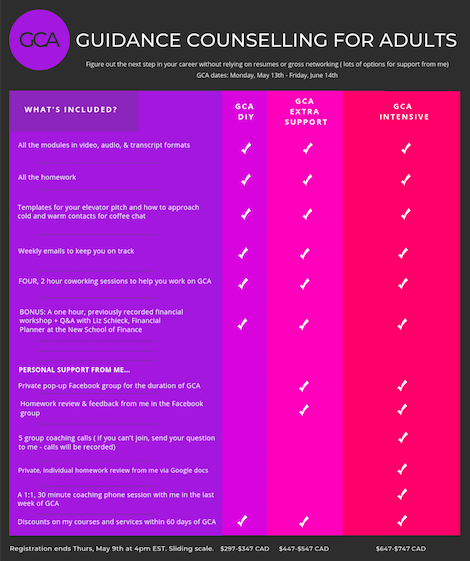
Want to register?
Just click the option you’d like and type in your sliding scale rate* (taxes may apply).
To register for GCA: DIY – click here (sliding scale $297-$347).
To register for GCA: Extra Support – click here (sliding scale $447-$547).
To register for Intensive – click here (sliding scale $647-$747). Only 10 3 spots left.
*There’s a sliding scale guide on the link above. If you identify as a person of colour (POC), queer, trans, chronically ill or disabled, please feel free to pay the lower end of the scale.
I do not require any documentation for your sliding scale selection so please don’t take advantage of it. It’s there for folks who need it.
What happens after you click the link to register?
You’ll receive a confirmation email within 24 hours with a questionnaire so that I can learn more about your specific situation.
You’ll also get an email with login details for the GCA course platform. You’ll get immediate access to the Welcome Module and Module 1 so you can get going even *before* we officially start.
You’ll get access to the rest of the course on the first day (May 13th).
So what do you think?
Ready to join Guidance Counselling for Adults?
Just choose your GCA option and sliding scale rate here: https://kathrynmeisner.com/gca
Have any questions or concerns? Something unclear? Email me: kathryn[at]kathrynmeisner.com
A note about the sliding scale
*There’s a sliding scale guide on the link above. If you identify as a person of colour (POC), queer, trans, chronically ill or disabled, please feel free to pay the lower end of the scale.
I do not require any documentation for your sliding scale selection so please don’t take advantage of it. It’s there for folks who need it.